
Six books. Six cities. One woman who refuses to be background.
Every title in Cut to Black is a film production term that doubles as a thematic knife. América Bracho Montiel doesn’t just solve crimes. She exposes what the industry does to people when the cameras aren’t rolling.
Book One · First Position
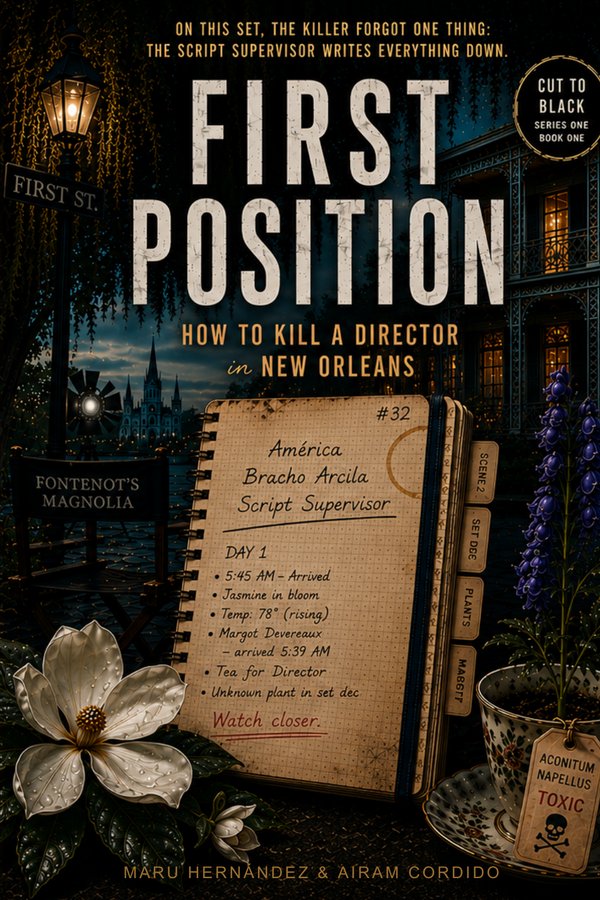
How to Kill a Director in New Orleans
On this set, the killer forgot one thing: the script supervisor writes everything down.
América notices everything. It’s her job. As script supervisor on the most expensive film shooting in New Orleans, she tracks every detail: every prop position, every costume, every line of dialogue against what came before.
On Day 1, she notices a blue-purple stain on the production designer’s thumb. By Day 3, she has identified the plant. By Day 5, she understands what is being planned, and why. The motive reaches back thirty years, to a Venezuelan woman named Valentina Devereaux, a stolen screenplay, and an industry that decided one person’s story belonged to someone else.
América has no badge. No jurisdiction. No authority. What she has is her camera, her continuity notebook, and the trained eye of someone who has spent fifteen years making sure the story matches.
In this industry, it rarely does.
Published in English, in Spanish as Primera Posición, and in French. By Maru Hernández & Airam Cordido.
América Bracho Montiel
América is not a detective. She is a reader of sets: she understands how productions work, which means she understands how power moves when everyone is pretending to be collaborative. Sharp, sarcastic, Venezuelan, and underestimated by every person she has ever solved a case in front of. She finds this useful.
Her grandmother, also named América Bracho Montiel, appears in fragments across both series: documents, letters, one photograph. By the end, we understand who she was.
These are not mysteries where the film world is charming and eccentric. The film world here is beautiful, corrupt, brilliant and brutal, exactly as it is.
Series One · Cut to Black
A director is found dead on a soundstage. Everyone has motive. Most of them have SAG cards.
Theme: Power, and who gets to hold the megaphone.
She spent forty years being invisible on set. Now she’s dead, and nobody noticed.
Theme: Erasure: the people who make films possible and are never remembered.
Everyone in Hollywood knows the third act is where it all falls apart.
Theme: Authorship, and who owns a story.
Golden hour lasts eleven minutes. That’s exactly how long it took to kill him.
Theme: What we choose to see, and what we frame out.
Pickups are what you shoot when you didn’t get it right the first time.
Theme: Editing as truth-telling.
Final cut is the right to decide what the audience sees. She’s taking it back.
Theme: Who controls the narrative.
The International Files
The cases that couldn’t stay in one country.
A Palme d’Or-nominated Moroccan-French actress vanishes the night before her premiere. On her kitchen table: a single 35mm frame.
A film restoration specialist is found dead in the Cinecittà vaults. The films she “restored” match no known record.
A documentary filmmaker who sent three executives to prison is killed the week his new film locks. Nobody knows its subject.
A festival programmer is killed during opening week. She rejected the one film everyone assumed was a lock.
A legendary 83-year-old editor dies at his table. His forty-year personal film is gone; in its place, one empty frame, looped.
América goes home. The final case connects to her grandmother, to First Position, to everything.